INEC rejected requests to cancel election
Nigeria’s ruling party candidate, Bola Tinubu, was declared president-elect of Africa’s most populous nation in the early hours of Wednesday after a weekend election that the main opposition parties have disputed.
Tinubu, a former governor of Lagos state, will take over leadership of a country grappling with Islamist insurgencies in the northeast, armed attacks, killings and kidnappings, conflict between livestock herders and farmers, cash, fuel and power shortages, and perennial corruption that opponents say Buhari’s party has failed to stamp out, despite promises to do so.
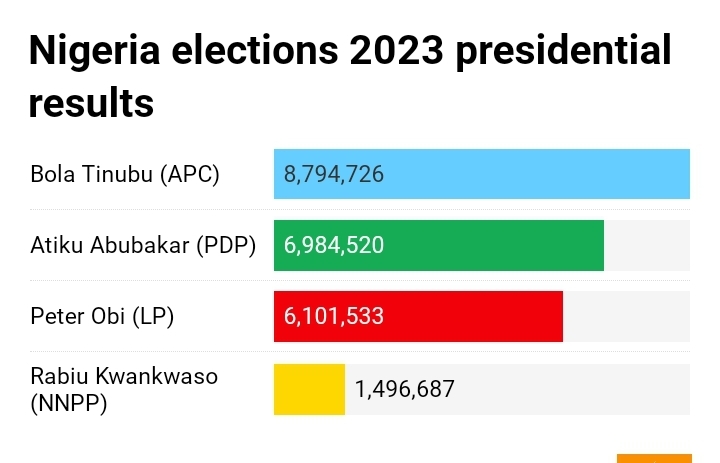
The Independent National Electoral Commission (INEC) said Tinubu garnered 8.79 million votes, ahead of main opposition challenger Atiku Abubakar’s 6.98 million votes. Peter Obi, an outsider popular with younger voters, garnered 6.1 million votes
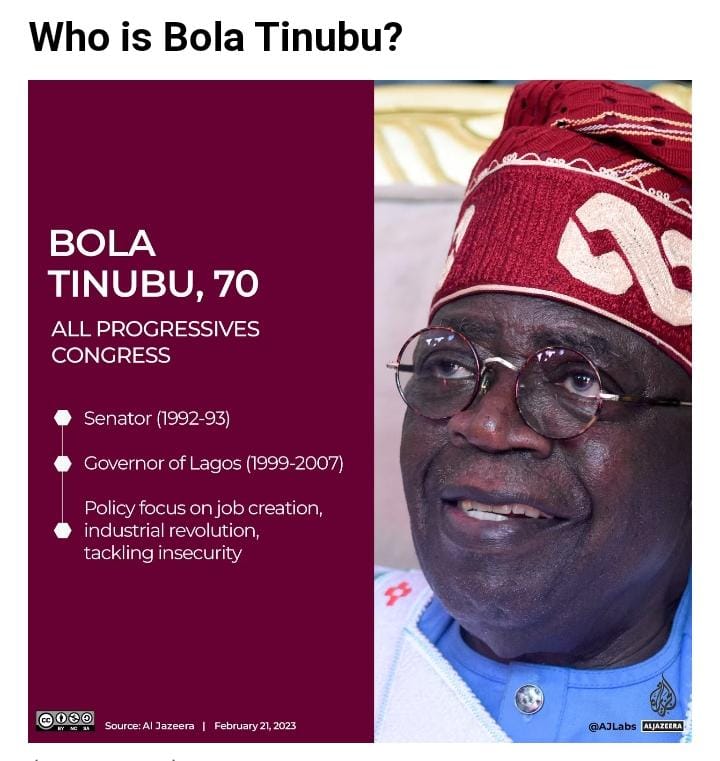
A two-term governor of Lagos, Nigeria’s economic capital, Bola Tinubu is credited with raising the state’s revenue, and supporters say he will replicate his success on the national stage
has courted controversy by doing what was considered unthinkable for more than three decades, selecting Kashim Shettima, ex-governor of Borno, as his running mate. Tinubu and Shettima are both Muslims, from the southwest and northeast, respectively.
Ahead of Saturday’s vote, they argued that competency overrules religion.
Ideology barometer
In parts of Africa, personality-driven politics and patronage culture are still dominant, so ideology politics is not as entrenched on the continent as it was under military regimes.
Political actors are frequently crossing party divides and changing their stance on national issues depending on the stage of their career and other variables in an electoral cycle.
Below is an approximate representation of their ideological standing – economically and culturally
Bola Tinubu – the ‘godfather’ set to lead Nigeria
President Muhammadu Buhari is stepping down after two terms in office, marked by economic stagnation and growing insecurity around the country – from an Islamist insurgency in the north-east to a nationwide crisis of kidnapping for ransom and separatist attacks in the south-east.
Mr Tinubu now has the task of solving these problems, among others, in Africa’s most populous nation and biggest oil exporter.
After fighting military rule in Nigeria, escaping into exile and being one of the founding members of the country’s democracy in 1999, Mr Tinubu will feel that he was destined to become president.
He was always the favourite to replace Mr Buhari – whom he helped become president – and the hurdles he has surmounted to get here will make this an even sweeter win for him.
He was not expected to win the party primary, yet he won.